

For the last three days I have attended the biannual Norwegian physicists meeting, this year hosted by my department at NTNU. I had a couple of contributions, which I will briefly post here.
PHYSICS AND BILDUNG
Firstly I had a presentation, named
Engaging physics students in society through a Bildung-oriented physics education
There was no attached paper, but I will paste the abstract below:
Based on the combined results of five different papers examining the relationship between physics education and Bildung, i.e. how we create physics students that engage themselves in society, this presentation presents several datasets from physics students. The presentation will also make suggestions on how we can build this engagement.
Physics students show a strong commitment to the epistemic values of science, and are open to using these also in other areas than physics. They have a strong motivation based on intrinsic interest in the subject they study, and to understand how the world works. In this they differ from e.g. engineering students who to comparison have a strong motivation toward their future profession. The distinct differences between student groups within STEM (science, technology, engineering, mathemathics), creates an argument for tailoring the teaching of Bildung-oriented or STS (science, technologi, society) aspects of the education, to the individual student groups, rather than lumping these topics together in large general courses.
This presentation will discuss how this can be done for physics students.
THE FUTURE OF PHYSICS
I also chaired a plenary session, including a panel debate.
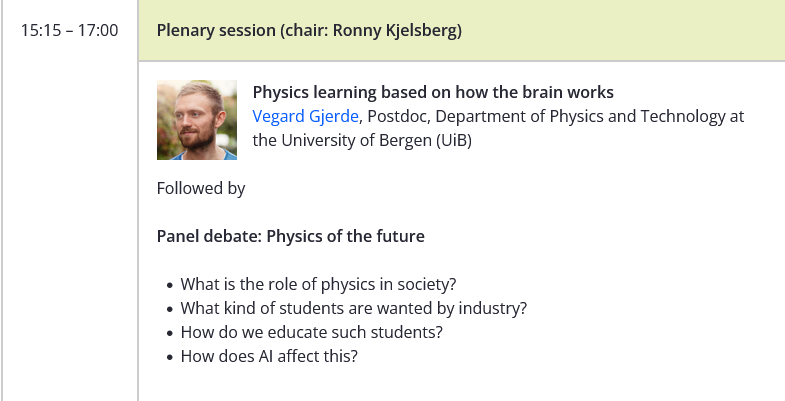
In addition to the presenter from UiB, the panel consisted of the head of department of physics here at NTNU, and the deputy head of department for research at UiO.
I will merely paste my prepared introductory remarks on the future of Physics below.
I won’t paint a wholly black picture, but there are dark clouds on the horizon.
In Norway we see a slow but steady decline of students that choose physics in upper secondary education. Over 10 years the number of students that take Physics 2, have gone down from 4600 to 2800. We also see university programs struggling. Here at NTNU and at UiO we are keeping the tendency at bay for now, but across the rest of the country the situation does not look so good, and I fear that if we do nothing, also those of us who have physics programs with relatively good application numbers, will just be the polar bears standing on the slightly large ice sheets watching other bears drown.
So this is one part of the situation – what do we need to do with the status of physics in society to engage more young people to go into the field?
Secondly we see science under attack. Colleagues in the US, working in climate adjacent fields of physics are being attacked by their own government. Iranian nuclear physicists are being singeled out for assasination by a foreign government.
Physics is definitely back in the public eye, however, not just in a sense where physicists are heroes of progress, but rather where we are seen as threats or victims. This may not be the focus we want to recruit future physicists.
So I would like to start with an open round:
Physics as a fundamental science affects very many diverse areas of society, and we also have a long history of physicists engaging themselves in societal issues related to their field, like the Union of concerned scientists or the Pugwash conference. Today we live in a somewhat volatile world.
What is the role of physics in society, and what roles should physicists take? Do we have responsibilities? Is physics in crisis, and if so – what should we do about it?
———-
Postscript:
A discussion I had later on in the conference coupled the two themes together. Perhaps the reason physics is not recognized in society in the way it deserves, given its importance and impact on society, is that we don’t educate physicists who engage with society. How many physicists sit in the national parliament, e.g., or hold other influential political or public positions?