
By coincidence, just days after I posted another update on a book I had contributed to, another volume where I have a chapter is out. This volume is edited by Larry Bencze, whom I met at the 2019 ESERA conference in Bologna. Without the conversation we had then I probably would not have parttaken in this great collaboration.
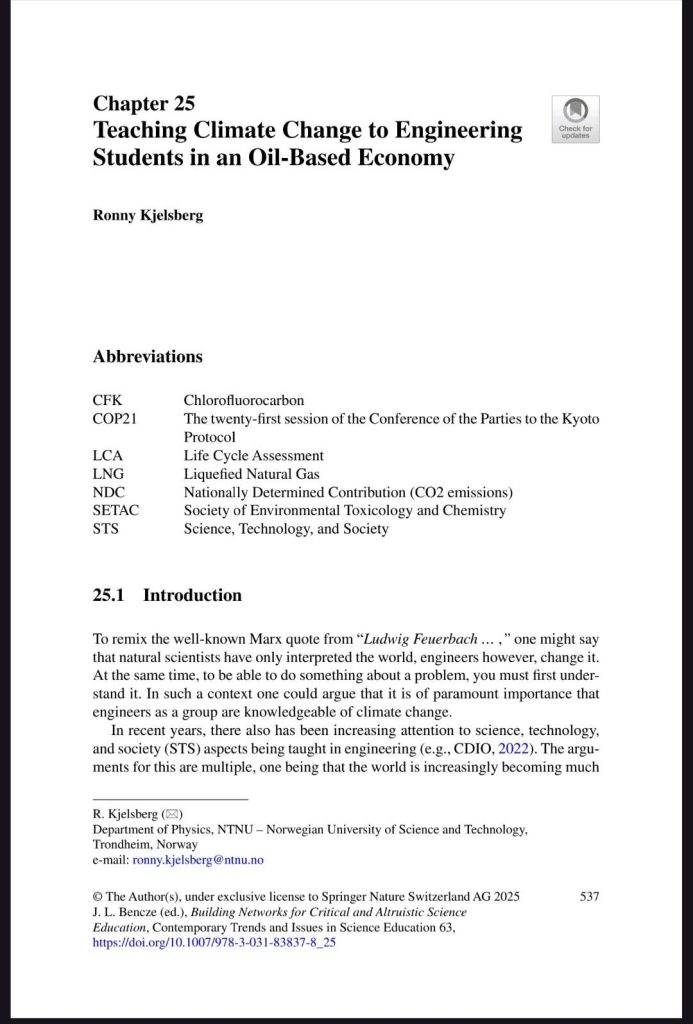
My chapter is about teaching climate change to engineering students in an economy partially based on oil. Are there specific challenges? I believe there are.
The chapter is available from here, but unfortunately not open access. I will nevertheless inlude the abstract below: https://link.springer.com/chapter/10.1007/978-3-031-83837-8_25
<blockquote>Employing Antonio Gramsci’s concept of hegemony, this chapter discusses challenges and opportunities in teaching climate change to Norwegian engineering students. The chapter is based on experiences in developing and teaching the obligatory 1st-year course “Introduction to the Engineering Profession” which, in addition to sustainability, consisted of several STS-adjacent topics. These experiences are further illuminated through data on the composition and motivations of student groups.
Norway’s position as a large exporter of fossil fuels influences the hegemonic discourses around oil and climate change, including hegemonic struggles on topics such as sustainability and economic growth, and even the extent to which climate change is man-made. Many Norwegian engineering students go on to jobs in the fossil or fossil-adjacent industries.
At the same time, there are definite ambitions within engineering education to prepare future students for complex futures, specifically by including sustainability in engineering education (CDIO, 2022), and reshaping engineering education more along lines of the central/northern European tradition of Bildung (Hellesnes, 1992; Klafki, 1975) creating not just engineers, but citizens (Kjelsberg & Kahrs, 2020).
This educational task entails navigating a field with various forces working in many different and often opposing directions, which again creates needs for very conscious approaches to teaching these topics to future engineers. This necessarily includes engaging with, and taking part in, these hegemonic struggles, and having a planned approach to teaching STS, scientific method, and climate change.</blockquote>